


PTE Summarize Written Text
Guía completa y consejos para PTE Summarize Written Text (Academic, UKVI & Core)
Una parte fundamental del Pearson Test of English es la tarea "Summarize Written Text" de la sección Writing. Esta pregunta del test de práctica PTE comprueba qué tan bien comprendes un pasaje, identificas sus ideas principales y las presentas con claridad en una sola oración. También evalúa tu gramática, tu comprensión de reading y tus habilidades de writing, todas importantes para mejorar tu puntuación general de PTE.


PTE Summarize Written Text: ¿qué es esta tarea?
En esta tarea de los exámenes PTE Academic y UKVI, recibirás un pasaje o un tipo de debate. Comprueba tu comprensión de reading y tu precisión en writing. En los 10 minutos disponibles, debes resumirlo de forma eficaz en una sola línea de 5 a 75 palabras.
Nota: Para PTE Core, puedes escribir más de una línea y el límite de palabras es de 25 a 50. El tiempo será el mismo (10 minutos). Puedes usar más de una oración.
Verás la imagen de abajo y, cuando alguien haga clic en el icono de reproducción, comenzará el vídeo de abajo.
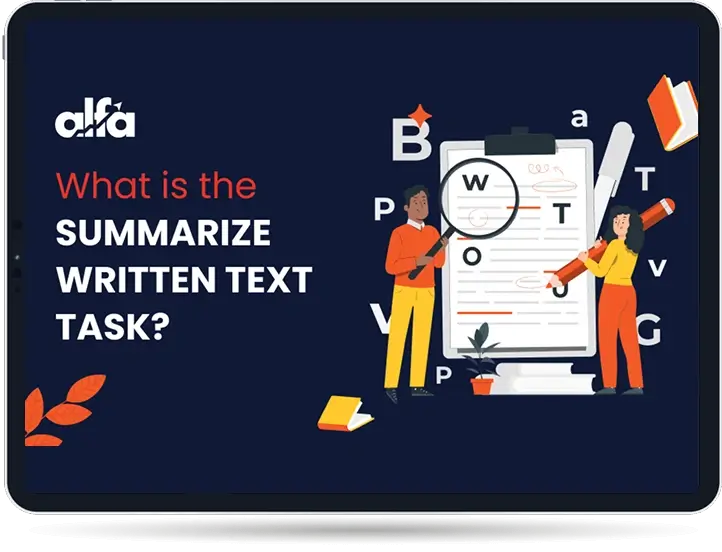
Tipos de pasajes en la tarea Summarize Written Text PTE
El objetivo de cada Summarize Written Text es resumir un pasaje en una sola oración. El estilo y el contenido de la oración pueden variar. Conocer el tipo de pasaje te ayudará a organizar tu resumen y a identificar los puntos clave más rápido.

Pasajes Academic
Provienen de fuentes académicas o de trabajos de investigación. Suelen incluir ideas y palabras difíciles de entender. Concéntrate en encontrar el punto principal del argumento o del resultado del estudio.
Ejemplo: historia, ciencia y educación.

Textos con opiniones
Estos pasajes plantean un argumento o muestran un punto de vista concreto. Para resumirlos bien, busca el punto de vista principal del autor y las pruebas que lo respaldan.
Ejemplo: problemas sociales, debates sobre políticas y cuestiones ambientales.

Textos que describen o explican
Explican con detalle un proceso, una idea o un acontecimiento. Identifica cuál es la idea principal y cómo se explica.
Ejemplo: fenómenos naturales, hechos históricos y procesos tecnológicos son algunos ejemplos de temas.

Pasajes que comparan o contrastan
Estos textos analizan al menos dos ideas, teorías o sistemas en paralelo. Presta atención a las principales diferencias o similitudes que se tratan.
Ejemplo: modelos económicos, prácticas culturales y teorías científicas.

Oraciones de causa y efecto
Explican qué ocurrió y por qué. Asegúrate de incluir la relación principal de causa y efecto en tu resumen.
Ejemplo: los efectos del cambio climático, el comportamiento de las personas en la sociedad y los avances médicos.

Summarize Written Text
En esta tarea, verás un texto en la pantalla. Debes leer el texto en voz alta con claridad y naturalidad. Tendrás 35 segundos para completar la reading, así que céntrate en mantener la claridad, la pronunciación correcta y un ritmo natural.
Sample Question 1:

Sample Question 2:
Sample Question 3:

Consejos para triunfar en la tarea de práctica PTE Summarize Written Text:

Tómate tu tiempo con la reading del pasaje:
Dedica algo de tiempo a entender la idea principal y los detalles importantes del pasaje. Una reading activa te ayudará a comprender lo que quiere decir el autor.
Anota los puntos principales de inmediato:
Presta atención al principio, al final y a las ideas que se repiten. Registra mentalmente las ideas más importantes que quieres incluir en tu resumen.
Escribe una sola oración clara y coherente:
Debes resumir todo en una sola línea de 5 a 75 palabras. Usa "which," "while," "as a result," o "however" para lograr transiciones fluidas entre las ideas.
No incluyas detalles pequeños o poco importantes:
No intentes cubrir todos los puntos. Cíñete a la idea principal y a los detalles más importantes que la respaldan. Demasiados detalles pueden alargar o confundir la oración.
Revisa la ortografía, la gramática y el número de palabras:
Asegúrate de que el uso de mayúsculas, la puntuación y el orden de la oración sean correctos. Comprueba dos veces que la línea termine con un punto final.
Cómo resolver con eficacia el Summarize Written Text en PTE
Un método planificado te ayudará a garantizar que tu resumen sea correcto y preciso. Trabaja tu comprensión de reading, tu writing y la organización de las oraciones.
Estrategia paso a paso

No te preocupes, léelo todo:
Léelo entero una vez para hacerte una idea general. Vuelve a leerlo para encontrar la idea principal y los puntos más importantes que la respaldan.

Céntrate en los puntos principales:
Presta atención a las frases de transición y a las oraciones temáticas que muestran causa, contraste o conclusión.

Haz un esquema mental:
Decide qué contendrá la oración: la idea principal y una o dos características de apoyo importantes.

Escribe una sola oración coherente:
Empieza por la idea principal y usa conectores para enlazar los demás puntos de forma coherente.
Ejemplo: El pasaje dice que hacer ejercicio con regularidad es bueno para la salud mental porque reduce el estrés y mejora el estado de ánimo, lo que hace que las personas estén más sanas en general.
Ejemplo: El pasaje dice que hacer ejercicio con regularidad es bueno para la salud mental porque reduce el estrés y mejora el estado de ánimo, lo que hace que las personas estén más sanas en general.

Reléelo antes de enviarlo:
Asegúrate de que respeta el límite de palabras (5–75 palabras) y revisa la gramática, la puntuación y la legibilidad.
Al leer distintos tipos de pasajes y practicar con regularidad, puedes sentirte más seguro de hacerlo bien en la tarea Summarize Written Text, lo que al final te ayudará a obtener una puntuación más alta en PTE Academic, UKVI.
Al leer distintos tipos de pasajes y practicar con regularidad, puedes sentirte más seguro de hacerlo bien en la tarea Summarize Written Text, lo que al final te ayudará a obtener una puntuación más alta en PTE Academic, UKVI.
Usa el vídeo completo para PTE Summarize Written Text


Más información sobre otras PTE preguntas
Tu guía para cada sección del examen PTE

Speaking

Reading

Preguntas frecuentes
Aquí hay respuestas a algunas preguntas frecuentes.
¿Cuántas preguntas de Summarize Written Text podemos esperar en el examen PTE?

Cada examen tendrá una o dos tareas de Summarize Written Text.
¿Cuánto tiempo tengo para completar la tarea Summarize Written Text?
Tienes 10 minutos para hacerlo.
Nota: Es una tarea independiente, lo que significa que terminarla antes no cambia el tiempo de las demás tareas. Para obtener mejores notas, siempre se recomienda usar todo el tiempo para redactar bien tu respuesta. Esta tarea contribuye tanto a reading como a writing, por lo que vale bastantes puntos.
Nota: Es una tarea independiente, lo que significa que terminarla antes no cambia el tiempo de las demás tareas. Para obtener mejores notas, siempre se recomienda usar todo el tiempo para redactar bien tu respuesta. Esta tarea contribuye tanto a reading como a writing, por lo que vale bastantes puntos.
¿Cuántas oraciones podemos usar en la tarea PTE Summarize Written Text?
Solo se puede usar una oración para esta tarea. Debe ser gramaticalmente correcta y resumir de forma eficaz toda la información importante del pasaje dado.
¿Puedo editar mi respuesta durante la tarea PTE Summarize Written Text?
Durante el tiempo disponible, puedes hacer cambios tantas veces como quieras.
¿Qué impacto tiene la tarea PTE Summarize Written Text en mi puntuación?
Esta tarea afecta tanto a las habilidades de reading como a las de speaking, porque comprueba lo bien que entiendes lo que lees y lo bien que escribes.